
Every speech-to-text model faces a trade-off between context and accuracy. Teach it the names and terms someone uses, and it starts to hear them everywhere. But the more a model leans on that context, the more often it writes those words in where they were never said.
Today, we're launching Canto-2, our most accurate speech-to-text model yet. Canto-2 recovers hard names and terms accurately nearly 7 of 10 times, without more false insertions. It makes a third fewer mistakes across 14 languages, and has the lowest Hindi error rate of any multilingual model on Hugging Face’s open benchmark. It is 10 times the scale of Canto-1, and our biggest step yet toward dictation that's ready to send without a single edit.
Balance context and accuracy
The words that matter most in a message are often the ones a speech model has never heard: a coworker's name, a client, a product, a file in a codebase. Flow's dictionary teaches Canto those words, and Canto-2 is trained to use them only when they're said. Add a coworker named Carrie, and "Carrie signed off" comes out right, while "carry this over" stays as written.
Canto-2 now gets 69% of the hardest names and terms right, up from 41% with Canto-1, without inserting them more often. It holds up as dictionaries grow, too: even with 1,000 saved terms, it gets 92% of the easier ones right. Every name it gets right is one less edit before a message goes out.
Built for real-world English
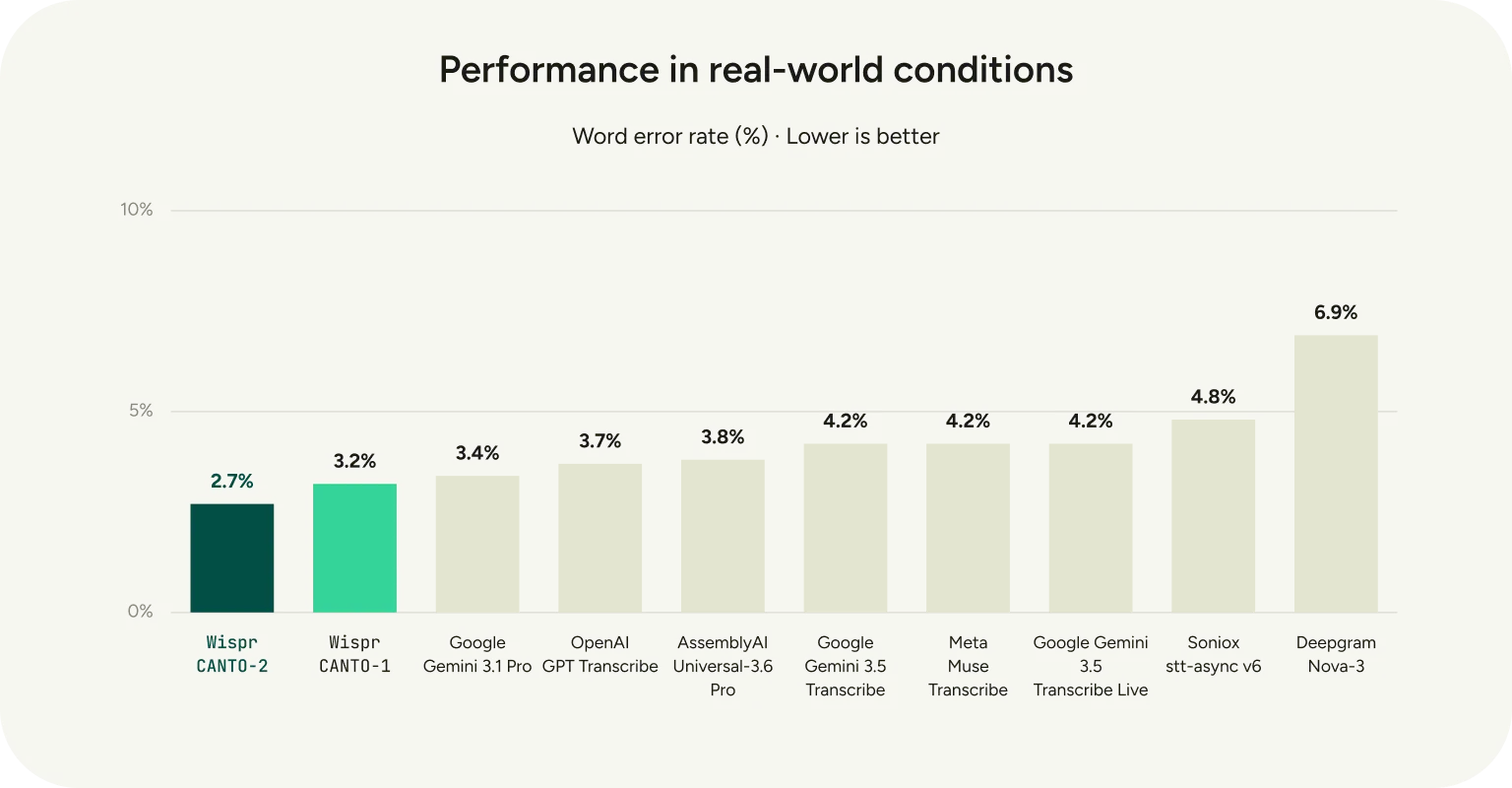
Most speech-to-text models learn from clean audio: people reading scripted sentences into good microphones in quiet rooms. Real dictation sounds different. It happens over background noise, on laptop and phone mics, in every kind of room, with sentences that restart halfway through.
Wispr builds its own models, so we can train it on the conditions people actually dictate in, test it against them, and fix what we find in the model itself. To measure how Canto-2 handles real-world conditions, we tested it on a random sample of real dictations from Flow. In English, it made more than 15% fewer errors than Canto-1 and had the lowest error rate of the speech-to-text models we tested.
Flow in any language
Many Flow users don't dictate in just one language. They move between two or three over a day, often within a single sentence. We tested Canto-2 against leading speech-to-text models. Across 14 languages, including Spanish, French, Hindi, and Mandarin, it had the lowest average error rate of the group and made a third fewer errors than Canto-1, down from 9.9% to 6.3%.
Every language has its own sound-alikes. In Spanish, only an accent separates "sí," meaning yes, from "si," meaning if. Hindi speakers often switch to English mid-sentence. Canto-2 keeps up without being told.
Voice only saves time if people can rely on what comes back, and Canto-2 brings Flow one step closer to dictation that's ready to send the moment someone stops talking.
You can read more about how we built Canto-2 on the Wispr Advanced Interfaces Lab blog. Canto-2 begins rolling out to Wispr Flow users today across all platforms.